Guides
Do federal northern loan programs fit Yukon, NWT and Nunavut transport costs?
Enterprise loan options in Yukon, NWT and Nunavut must price freight and missing collateral, because southern underwriting rules rarely fit northern files.
What to take away
- Enterprise loan options in Yukon, Northwest Territories and Nunavut have to be built around freight and collateral, not around a credit score alone.
- Federal northern loan programs, BDC and CanNor support can fund equipment, working capital and expansion, but each has its own eligibility test.
- A freight quote that holds for a southern city often doubles before it reaches Whitehorse, Yellowknife or Iqaluit, which changes debt service coverage.
- Territorial collateral is thinland claims, leasehold interests and moveable equipment need different security than a southern mortgage.
- Lenders who read a Northern territories file need a written explanation of distance, season and supply chain before they will price risk.
- Check every program directly before you apply, because northern allocations and caps change with each fiscal year.
Why a southern credit template misses the North
A southern lender runs a file through a template: revenue, margin, collateral, credit history. In the Northern territories, two of those inputs behave differently. Freight is a permanent cost line, not a one-time setup charge. Collateral is often a lease, a licence or a piece of equipment that is expensive to move and hard to sell.
The rest of the file often reads as weak. Many northern businesses are young, or they trade through a single customer such as a mine, a government department or a co-operative. A southern lender may treat that concentration as fatal, but a northern lender knows it is normal.
A file that looks weak on paper is not always a weak business. The fix is not to hide the facts. It is to explain them in the order a credit analyst reads, with a number attached to each one.
For a comparable problem in another sector, see how business loan brokers vs direct lenders handle a short trading record.
Federal northern loan programs and what they will actually fund
Federal northern loan programs are not one product. They are a set of instruments delivered by different departments and agencies, and each one funds a different part of a northern business. The Canada Small Business Financing Program supports term loans for equipment and leasehold improvements through participating lenders. Farm Credit Canada serves agriculture and agri-food borrowers, including northern producers.
The CSBFP ceiling has been $1,000,000 per borrower, with a lower sub-limit for working capital and intangible assets, and the rate is capped at the lender's prime rate plus 3 percent. Confirm both figures with a participating lender, because they are set by regulation and do change.
Export Development Canada can help a northern business that sells outside Canada, which often means a tourism operator, a seafood processor or a manufacturer shipping south. The Business Development Bank of Canada works directly with small and medium sized enterprises on term loans, working capital and equipment financing.
What these programs will fund is usually clear: a piece of equipment, a building improvement, a vehicle, a line of credit for seasonal stock. What they will not do is erase a freight cost that is already in the business. A loan can finance the inventory, but the shipping invoice still has to be paid from margin.
That distinction matters when you build a request. If you ask for a loan to cover freight, a lender may see an operating loss. If you ask for a loan to cover the inventory that the freight delivers, and you show the margin after freight, the request is legible.
The same logic applies across sectors, and you can see how it plays out in franchise financing vs startup loan terms.
Northern allocations are limited. CanNor contribution budgets are set by fiscal year, which runs from April 1 to March 31, and a stream can close once its allocation is committed. CSBFP is demand driven and has no annual window, and BDC lends year round.
Check the current intake dates on each program page rather than applying early on a guess.
If your business is owned by a First Nation, a Metis organization or a northern community, there are dedicated programmes outside the main federal stream. Saskatchewan publishes a clear model of how these are structured: First Nations, Metis and northern community business programmes.
It is worth reading even if you are in the Northern territories.
BDC and CanNor support in Yukon, NWT and Nunavut
BDC and CanNor support are the two names a northern borrower hears most often, and they do different jobs. BDC is a Crown corporation that lends directly. It offers term loans, working capital, equipment financing and advisory services, and it has offices that serve the Northern territories.
BDC term loans commonly start around $100,000 and run into the millions. Repayment terms commonly run up to 10 years, and longer for owner-occupied real estate. Pricing is set case by case, usually as a spread over prime.
Its financing structures are published here: BDC financing solutions.
CanNor is the federal regional development agency for the North. Its business-facing streams include the Northern Business Development program and Regional Economic Growth through Innovation, and it also delivers community economic development funding. A contribution agreement can fund a feasibility study, a market expansion, a piece of equipment or a training programme.
CanNor is not a bank, and it does not replace a loan. Awards are sized per project. Typical northern contribution agreements run from tens of thousands of dollars to a few hundred thousand, and the agency funds a share of eligible costs rather than all of them. CanNor publishes the maximum for each stream.
The practical difference is speed and purpose. BDC can move on a term loan for a truck, a kitchen or a workshop. CanNor can fund the study that tells you whether the truck, kitchen or workshop will pay. Used together, they cover the gap between an idea and a financed asset.
In Yukon, a tourism operator might use CanNor support to test a new winter product, then use a BDC loan to buy the snowmobiles and safety gear. In Northwest Territories, a supplier to the mining sector might use a contribution to certify a process, then finance the equipment with a term loan.
In Nunavut, a food retailer might use support to study a new storage system, then borrow against the equipment.
The Government of Northwest Territories publishes its business financing programs in one place, including northern cost considerations, which is a useful comparison if you operate in more than one territory: NWT business financing programs.
Territorial governments also run their own programmes. Northwest Territories businesses can borrow from the Business Development and Investment Corporation (BDIC) and apply for Support for Entrepreneurs and Economic Development (SEED). Nunavut's main territorial lender is the Nunavut Business Credit Corporation, which makes loans and loan guarantees alongside the Department of Economic Development and Transportation.
Yukon's business development arm, part of the Department of Economic Development, supports small business and film. These territorial programmes are separate from federal programs, and you can often stack them if the costs are distinct.
Stacking is where files go wrong. If two programmes fund the same invoice, the lender may reduce its own exposure. Map every cost to one source before you apply. A simple table of cost, amount and source stops double counting.
What freight does to a northern debt service calculation
A debt service calculation compares the cash a business generates with the payments it owes. In the Northern territories, freight sits inside both sides of that calculation. It reduces the margin on every sale, and it adds to the cost of the assets the loan buys. A southern lender who ignores it will understate the payment risk.
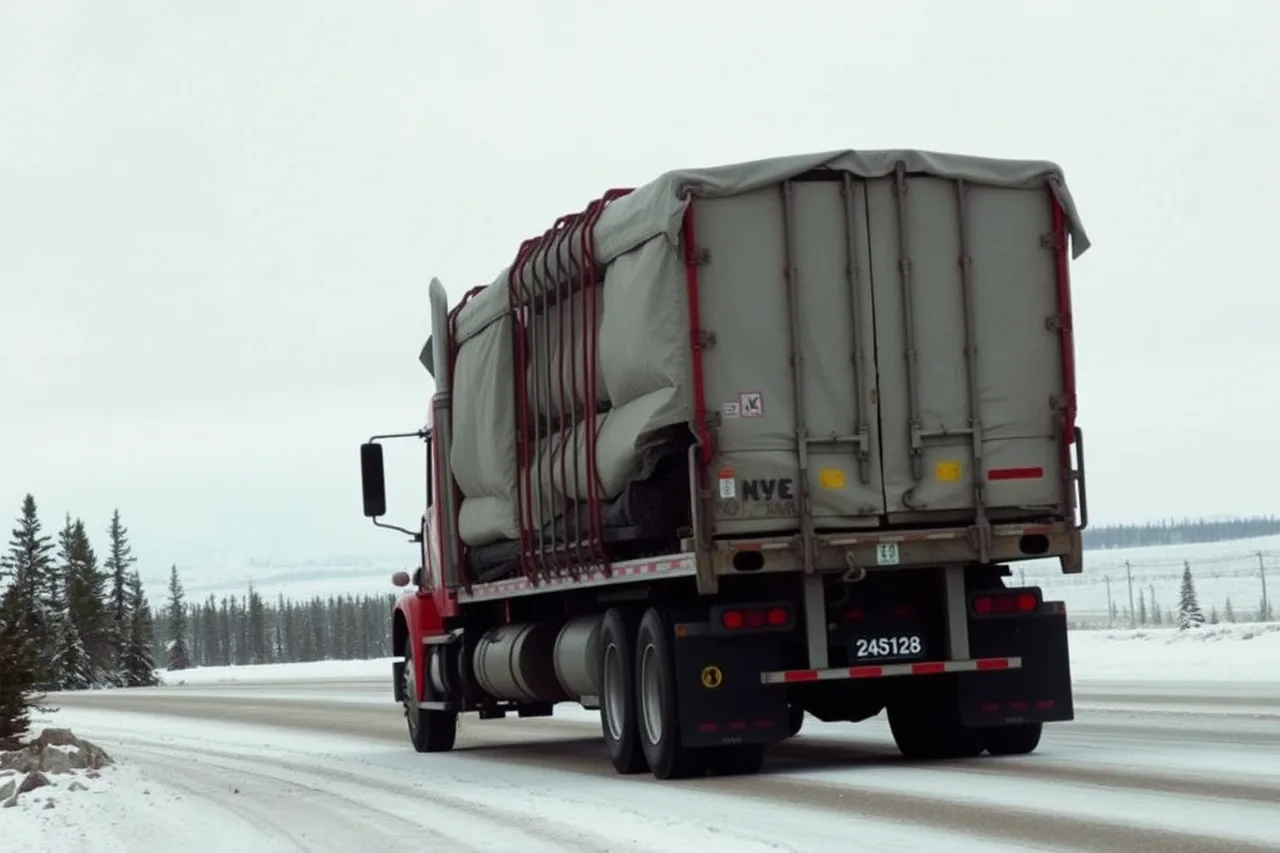
Distance sets the schedule. A truckload from Edmonton to Yellowknife travels the Mackenzie Highway for most of the year, but winter ice roads and ferry crossings set the timing. A shipment to Iqaluit usually arrives by sealift or air, and both have seasonal windows.
When a supplier misses a window, the business waits months, not days. A retailer in Whitehorse may carry eight weeks of stock because the next order cannot arrive sooner. A construction contractor in Nunavut may need to fly in a technician for a repair. Those costs land before the revenue they support.
Here is the arithmetic on one item. Typical, not a quote: a commercial freezer listed at $6,000 in Edmonton lands in Yellowknife at $7,200 to $7,800 once freight, fuel surcharge and insurance are added. The same unit by sealift to Iqaluit lands at $9,000 to $10,500. Miss the sealift and air freight can push the landed cost past $13,000.
That gap changes the payment. A $7,500 landed freezer financed over five years at 9 percent costs about $156 a month. Financed against the $6,000 catalogue price, the payment would be about $125, a fifth less than the cash the business has to find.
Then look at the replacement cycle. Northern equipment works harder and is serviced less often. A vehicle may need to be replaced sooner, and the replacement will arrive with the same freight load. Your debt schedule should match that cycle, not a southern average.
Seasonal purchasing compresses into a few months. A business may draw a line of credit heavily in one quarter and clear it in another. A monthly payment that ignores this pattern will strain the account in the wrong month.
Fuel and power costs add to it. Many northern businesses pay more for electricity, heating and generator fuel than a southern peer. Those costs sit in overhead, and they do not disappear when revenue dips. A lender who compares your margin to a southern benchmark will misread the file.
Housing and living costs also feed into wages. The CMHC Northern Housing Report tracks costs across Yukon, Northwest Territories and Nunavut, and it shows why staff housing is a real line item for northern employers: CMHC Northern Housing Report. If you must house a worker, that cost belongs in your projections.
A file that puts a number on transport also supports a larger working capital facility. Seasonal stock, a late sealift and a slow mine payment all pull on the same account. Show the peak draw and the month it lands in, and the analyst can size the facility against it.
Collateral that does not exist in the territories, and what replaces it
Territorial collateral is a different asset class. In southern Canada, a lender may take a mortgage on a commercial building or a general security agreement over inventory. In the Northern territories, land ownership is often shaped by land claim agreements, and much of the land is held under title that a southern lender has never seen.
Settlement land, fee simple title in a municipality, leasehold interests and licences of occupation all behave differently. A lender may accept a leasehold charge if the lease is long and assignable. It may not accept a licence that can be cancelled. Before you apply, find out exactly what interest your business holds and whether it can be charged.
Moveable assets are often the better security. Vehicles, heavy equipment, kitchen equipment, aircraft and marine vessels can be registered under personal property security legislation in each territory. These registries work, and a lender who knows them can take security without needing a land mortgage.
Inventory is weaker security in the North. It is expensive to move, and a resale market may be small. A lender may lend against it at a lower advance rate, or exclude it. If inventory is your main asset, expect a smaller loan and a larger equity contribution.
Cash flow and contracts can replace some collateral. A long term contract with a mine, a government department or a large retailer can support a loan if the contract is assignable and the counterparty is strong. A supply agreement with a co-operative can do the same.
These are not collateral in the legal sense, but they are evidence of repayment.
Guarantees and personal security still matter. A personal guarantee from an owner with a home in Whitehorse, Yellowknife or Iqaluit carries weight, even if the home is modest. Insurers and program guarantees can also reduce a lender's exposure.
If your file is marked by thin collateral rather than poor payment history, read how no-doc business loans change what financiers trust.
Building a northern file a southern lender can read
The goal is a file that a credit analyst in Toronto, Montreal or Calgary can approve without a site visit. That means translating Northern territories facts into standard credit language, in the order the analyst expects. Do the work before you send the application.
Building a northern file
- Write a one page operating summary. State what you sell, who buys it, how it reaches the customer and how long that takes. Name the transport route and the seasonal window.
- Build a delivered cost sheet. Show the southern price, the freight, the duty, the insurance and the final landed cost for your main inputs. Use quotes, not estimates.
- Separate freight in your financials. Put it on its own line in the profit and loss statement so the analyst can see the margin before and after transport.
- List every asset and its legal interest. State whether land is settlement land, fee simple, leasehold or licensed, and whether it can be charged.
- Match the loan to the asset life. A vehicle, a building improvement and a piece of processing equipment have different lives, and the term should reflect that.
- Show your programme stack. List each federal, territorial or agency contribution, the cost it covers and the amount, so no invoice is funded twice.
- Add a downside case. Show what happens if a sealift is late, a mine slows down or a fuel price rises. A lender who sees the downside priced will trust the base case more.
- One page operating summary with route and season
- Delivered cost sheet with written quotes
- Margin after transport stated for the main inputs
- Asset list with legal interest stated
- Loan term matched to asset life
- Programme stack with no double funding
- Downside case with named triggers
Worked example: a Yellowknife supplier
A Yellowknife company supplies safety equipment to mining and construction clients. Revenue is steady, but the owner wants a term loan for a delivery truck and a larger parts inventory. A southern lender sees high freight, one large customer and no commercial building.
The file is rebuilt. The operating summary names the highway route and the winter road window. The delivered cost sheet shows the truck landed cost, including freight and surcharge. The margin after transport is stated for each main product line.
The asset list shows the truck as a registrable moveable asset and the leased yard as a leasehold interest with five years remaining.
The programme stack shows a CanNor contribution for a market study, a territorial programme for training and a BDC term loan for the truck. The downside case models a three month delay in a mine order and shows the cash buffer that covers it.
The lender approves a smaller loan than requested, with a term matched to the truck's northern service life.
That outcome is normal. The point of the file is not to win the full request. It is to give the analyst enough to price the real risk, so the decision is based on the business rather than on a template.
If a claim about your sector sounds too neat, it is worth checking a bdc loan vs bank loan canada claim before you rely on it.