Guides
Small business loans in Canada: security, documents and timing
Small business loans in Canada: how banks, credit unions, BDC and the CSBFP work, what security lenders take, and the documents a file needs to clear.
What to take away
- Canadian small business lending runs through four channelschartered banks, credit unions, the Business Development Bank of Canada, and the Canada Small Business Financing Program.
- CSBFP backs equipment and leasehold improvements. It leaves inventory and everyday working capital to other products.
- A personal guarantee is standard, so a default can reach the owner's house.
- Term loans suit assets that last for years. A line of credit suits a gap that closes.
- A complete file clears in roughly 5 to 15 business days. An incomplete one sits until someone chases it.
United States business owners can use this as a cross-border reference. The basic choice is the same in any market. Match the loan to what the money buys. Use term debt for equipment or build-outs. Use a line of credit for a receivable gap that closes. Expect a personal guarantee and a security interest.
The Canadian programs named here, CSBFP and BDC, do not lend in the United States. For a US file, the federal routes are the Small Business Administration's 7(a) and 504 programs, alongside bank term loans and online lenders. The questions to ask do not change: what is the collateral, what is the term, and what does the guarantee reach?
Where Canadian business lending actually sits
Chartered banks (RBC, TD, Scotiabank, BMO and CIBC among them) hold most business deposits in Canada. They price on relationship and security first, and they want two years of financial statements before they discuss a number.
Credit unions (Desjardins in Quebec, Vancity in British Columbia and many others) lend inside their own region and often weigh a borrower's local record. Ask whether a branch runs commercial lending at all before booking a meeting. The lenders for term loans comparison sets out what each institution is built to do well.
The Business Development Bank of Canada is a Crown corporation with a wider credit appetite. It funds equipment, working capital and expansion, and it sells advisory services alongside the loan. It takes files a chartered bank declines and prices for that risk. Business Development Bank of Canada
The Canada Small Business Financing Program is the government-backed route, created under the Canada Small Business Financing Act. Ottawa shares part of the lender's loss, but the lender still decides, and on an equipment loan it must take at least 15 percent additional security. The official CSBFP program page carries the current forms and terms.
What each product is built to fund
Typical amortisation
- Term loan
- 3 to 10 years
- Line of credit
- Revolving, reviewed annually
- Equipment loan
- Matched to asset life
- CSBFP-backed loan
- Up to 10 years
Main security
- Term loan
- General security agreement and personal guarantee
- Line of credit
- Receivables and inventory
- Equipment loan
- The asset itself
- CSBFP-backed loan
- Government guarantee to the lender, plus additional security
Fits
- Term loan
- Equipment, renovations, acquisition
- Line of credit
- Seasonal cash gaps
- Equipment loan
- Machinery, vehicles, trailers
- CSBFP-backed loan
- Equipment and leasehold improvements
Amortisation ranges in that table are illustrative. Every lender quotes from its own rate sheet.
Choose by what the money buys, not by the rate on the poster. Equipment holds resale value and can be repossessed. Working capital has no asset standing behind it.
An equipment financing deal that mismatches loan term and asset life squeezes cash in the final year. An eight year machine should not carry a four year note.
Example: a $60,000 delivery van
A bakery buys a used delivery van for $60,000. A chartered bank may lend against the van alone, on a shorter amortisation and a heavier monthly payment.
Under CSBFP the lender can stretch the term, because the government shares the loss. The lender must still take at least 15 percent additional security. That works out to roughly $9,000 in other business assets.
The statements and the business number gate the file either way. The van reaches the loading dock only if the dealer waits for funds.
The application, stage by stage
- Register the business number with the Canada Revenue Agency and open a business account.
- Pull two years of financial statements, or a notice of assessment for a younger company.
- Gather the supplier quote, delivery terms and any existing lease or lien documents.
- Submit one complete package to the lender whose mandate already fits the request.
- Sign the guarantee, register the security and draw the funds.
Most calendar time sits in steps two and three. An accountant needs two to four weeks for statements. A supplier quote takes a day.
How to qualify for a line of credit works differently. A revolving facility is reviewed on receivables and margin, not on the asset.
Documents that stop a file
Two missing items stop more files than any credit problem. The first is a business number. The second is financial statements that do not exist yet.
The checklist that follows is the loan document order most lenders expect. Work from the top down.
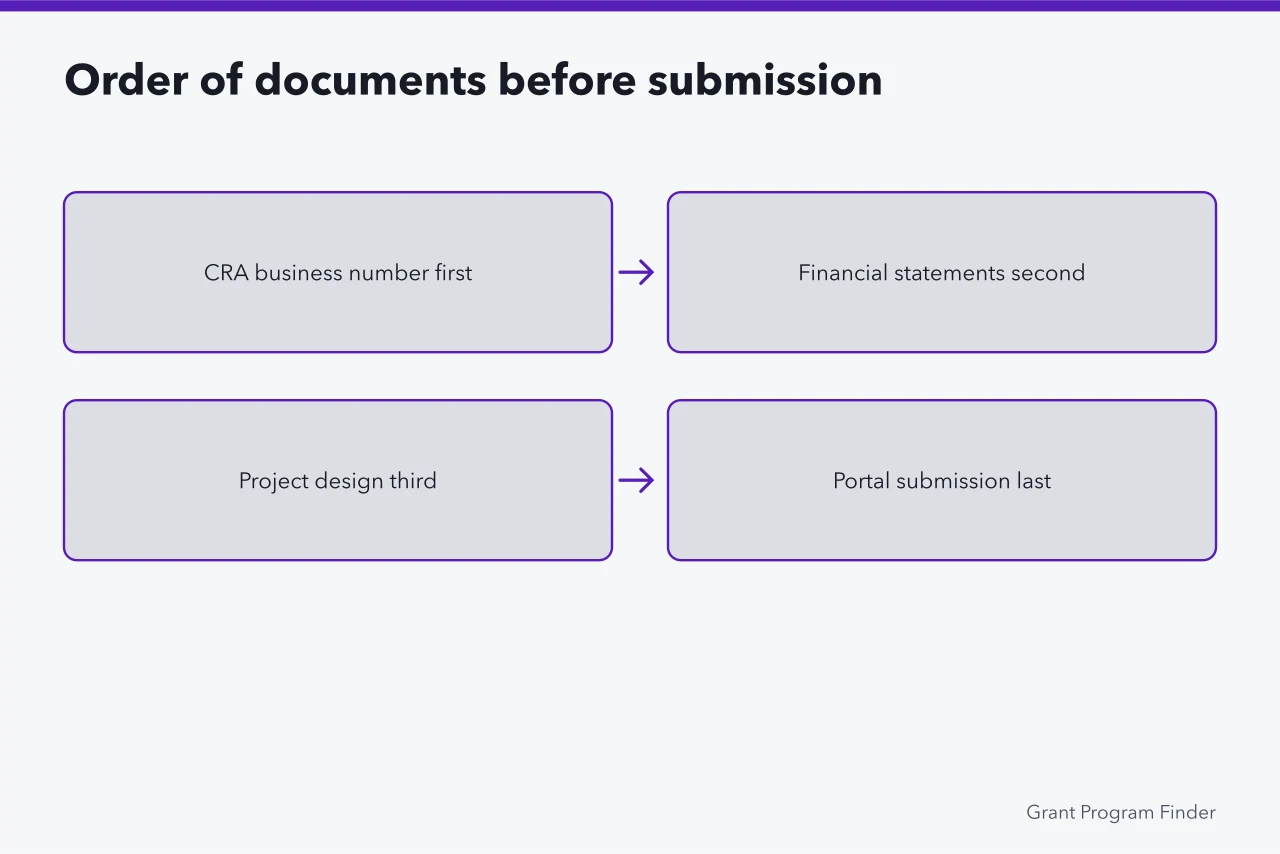
- Business number and CRA program accounts
- Two years of financial statements, or a notice of assessment
- Supplier quote or purchase agreement
- Personal net worth statement and guarantee consent
- Twelve months of business bank statements
A guarantee is not a formality. A Canadian lender can pursue the guarantor's personal assets, including a home, once the company stops paying. The definition of a personal guarantee covers that exposure.